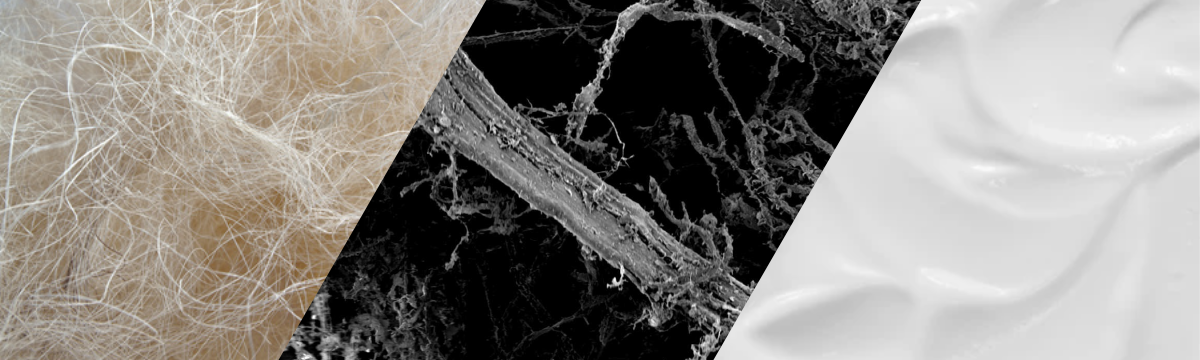
Temperature stability of Setralit® natural fibers
their use in friction linings and gaskets
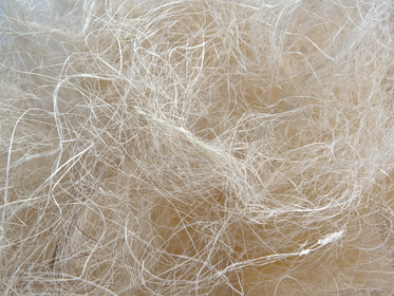
1) Temperature stability: Setralit® natural fibers are cellulosic and - if not embedded in a matrix – exhibit a stability range of up to 270 °C (but not with an unshielded flame, this would burn the fibers). At higher temperature values the fiber decomposes gradually, depending on intensity and duration of heat. Aramid is stable up to approx. 500 °C.
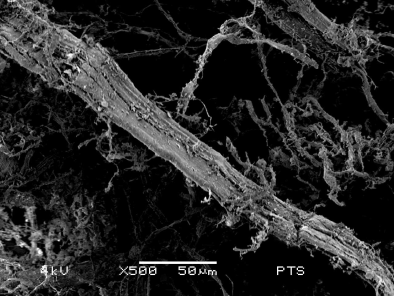
2) Unlike aramid, however – and this is the very advantage – the Setralit® fiber does not melt beyond 500 °C but can bear short-time temperature peaks of up to 800 °C (i.e. high thermo-shock stability), whereas the aramid fiber will definitely be ruined at those temperatures and moreover releases toxic degradation products. Temperature values like that may well occur on hard braking. The natural Setralit® fiber, however, does not degrade; at most it may carbonize at the proximate brake surface without loosing its structure.
3) If bonded within a matrix as realized in brake linings or gaskets, the stability behaviour of natural fibres may be completely different compared to that of a free fibre. It then depends on the chemistry of the matrix and maybe high-temperature reactions between cellulose (or its decomposition products) and the surroundings. This has to be tested for each single formulation, especially concerning highly sophisticated matrices, as in the case of friction linings.
4) It may be possible to increase the temperature stability of Setralit® natural fibres by special treatment (e.g. flame retardants). We are currently involved in an international project, which is (amongst others) subject to this topic. However, one has to be realistic about that the stability limit can scale up some 10 degrees centigrade at best. According to the present state of the art one will certainly not reach the 500 °C of aramid.
5) In friction linings a 100% substitution of aramid pulp by the Setralit® fibre is already realized without showing any quality loss. It always has to be our aim – also in the case of gaskets – to completely substitute aramid by Setralit®. But already a partial exchange (aramid- und natural fibre pulp can be mixed in all proportions) – can be accounted as a success.
6) A natural
fibre pulp based on plant fibres which is to be applied in a higher temperature
range (e.g. in high performance gaskets or injection moulding) has to be
properly cleaned. This can be guaranteed by using the ultrasonic technology.
All kinds of impurities (like herbal glues, scents, and dyes, maybe also fungi,
spores, or bacteria) still adhere to insufficiently cleaned plant fibres. They
singe or roast at raising temperature well below the stability limit of
cellulose and may cause colour changes or bad smells, or they may even uncontrollably
interact with the ambient chemistry. A clean Setralit® fibre, however, does not
change at all (neither itself nor the matrix) up to its stability bound. In the
temperature range above that limit only water and CO2 is released.
Without oxygen or oxidation by the matrix only carbon remains which in general
still exhibits a fibrous structure.
SETRALIT®-natural fibersThe ultrasonic methodThe basic raw material of SETRALIT®-Fibre is a non-wood natural fibre which is generally called “vegetable fibre”. In many cases this is a bast fibre like hemp, flax, nettle, kenaf... more MIPO® & MoS2Cold forging with MIPO: Lubricants and especially solid lubricants are used, not only to ease the movement direction of the cold metal under high pressure, but also to serve as separating agent, to fast... more SETRAL® - Lubricants
R&D Services: Setral develops and produces high performance as well as special lubricants... more
Job Order Production: We manufacture lubricants according to your instructions... more Private Label: We have the ability to produce and promptly deliver your own products. A multitude of packages... more Being an innovativ producer of high performance lubricants, setral supports our customers to gain effectiv profit by using high quality solutions. |